Diplopterys cabrerana


Botany
| Accepted name | Diplopterys cabrerana (Cuatrec.) B.Gates — accepted by Plants of the World Online |
| Basionym | Banisteriopsis cabrerana Cuatrec., published in Webbia 13 (1958). Gates published the present combination in Brittonia 31: 109 (1979) and treated the species fully in Flora Neotropica 30 (1982). |
| Family / order | Malpighiaceae · Malpighiales. |
| Life form | Large woody climber or liana, sometimes appearing shrubby while young or repeatedly cut; mature stems may become conspicuously flattened by asymmetric xylem. |
| Type locality | Caño Teemeña, a tributary of the Río Piraparaná and Río Apaporis, Vaupés, Colombia; type Schultes & Cabrera 17297 (Gates, 1982). |
| Documented range | South tropical America. Fertile records are reported from river margins in Amazonian Colombia, Venezuela and Brazil; sterile cultivated drug plants are documented from Colombia, Ecuador and Peru. In Colombia it is native and cultivated at approximately 100–720 m in Amazonian and Andean departments including Amazonas, Putumayo and Vaupés (Bernal, Gradstein and Celis, 2015; POWO, 2026). |
| Local names | Chagropanga / chagro panga, chaliponga / chalipanga, oco-yagé, yajé-uco, yagé oko, yageúco, yají, yagé; Gates also records Indigenous names including mené kahi ma, nyoko-buku guda hubea ma and ka-hee-ko. Names vary by language and may denote an ingredient, a cultivar, a recipe or another taxon. |
| Conservation | Not Red-Listed No species-level IUCN assessment was located. Colombia’s catalogue lists it as not evaluated; Kew’s 2024 model predicts “not threatened” with confident model support, which is a prioritisation estimate rather than a field assessment (Bachman et al., 2024; POWO, 2026). |
Morphology
Young branches carry close golden silky hairs and become nearly glabrous with age. Leaves are opposite, leathery and usually falcate-elliptic, about 10–21 cm long but occasionally larger, with a truncate base, a long acuminate tip and six to ten pairs of lateral veins. Petioles are channelled above; minute triangular stipules may be joined by an interpetiolar line. The lower leaf surface is sparsely appressed-sericeous, and minute glands occur along the margin (Gates, 1982).
Axillary inflorescences consist of four-flowered umbels borne singly or in condensed clusters. The flowers have five unequal yellow, fringed petals and paired oil glands on most sepals, a characteristic Malpighiaceae pollination architecture. The dry fruit divides into three mericarps. Each nut bears a tall crest-like dorsal wing and irregular lateral ridges or winglets; Gates proposed that the air-filled locule and sculpted wings may assist flotation and river dispersal. Fertile material is uncommon in cultivation.
The rusbyana problem
Banisteriopsis rusbyana (now generally Diplopterys longialata) is not a straightforward synonym of D. cabrerana. Morton attached the name B. rusbyana to a sterile collection of the drug plant in 1931, and ethnobotanical and chemical publications repeated the identification. Gates compared fertile structures and concluded that the ritual material represented Cuatrecasas’s B. cabrerana; she explicitly described B. rusbyana as a misapplied name in this context (Gates, 1982). Older references remain valuable, but their taxon must be read through this nomenclatural history.
The practical uncertainty has not disappeared. Dried leaves lack flowers and fruits, while cultivated vines may remain sterile for years. D. longialata and other Malpighiaceae are also used or traded under overlapping names. A voucher linked to fertile material, DNA data and chemical analysis provides the strongest identification; a marketplace label or a DMT-positive test establishes neither species nor cultural provenance. Recent image-based machine learning distinguished authenticated D. cabrerana from several B. caapi folk types with high accuracy, but it was an outgroup in a limited collection, not a universal field key (Biazatti et al., 2026).
Propagation and cultivation
The plant is commonly transplanted by stem cuttings into forest clearings, house gardens and specialist medicine gardens. Gates observed that many herbarium vouchers were sterile drug plants and that Indigenous cultivators sometimes planted them in secluded forest sites. Vegetative propagation preserves desired clones and moves them beyond the known fertile range, obscuring the boundary between wild distribution, ancient cultivation and recent introduction (Gates, 1982).
Established plants require a warm, humid climate, organic soil, reliable moisture and a support on which to climb. Repeated pruning supplies leafy regrowth and keeps a large liana within a garden. Published agronomic studies specific to authenticated D. cabrerana remain scarce; statements about germination, yield and alkaloid stability are often transferred from informal cultivation rather than replicated trials.
Chemistry
Entheogenic & associated compounds
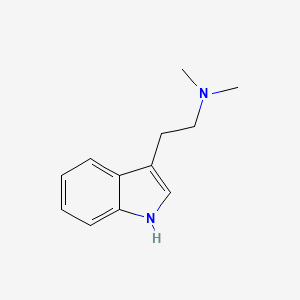
N,N-Dimethyltryptamine

N-Methyltryptamine

Bufotenine
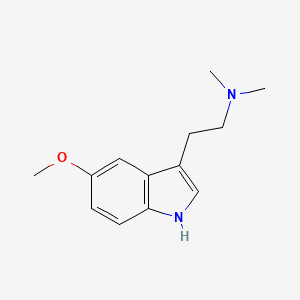
5-Methoxy-DMT
What is securely established
Two 1968 studies of material then called Banisteriopsis rusbyana documented abundant DMT in leaves used by Indigenous communities. Agurell, Holmstedt and Lindgren also reported N-methyltryptamine and trace 5-methoxy-DMT, bufotenine and N-methyltetrahydro-β-carboline. Gates’s taxonomic revision identifies the drug plant in those reports as D. cabrerana (Der Marderosian, Pinkley and Dobbins, 1968; Agurell, Holmstedt and Lindgren, 1968; Gates, 1982). Later reviews commonly cite total leaf alkaloids around 0.7%, predominantly DMT, but published samples vary and historical percentages should not be converted into assumptions about an unvouchered plant.
The widespread statement that chaliponga is characteristically a 5-MeO-DMT plant rests largely on those trace older findings and their repetition. Contemporary surveys of traditional and analogue brews have not established 5-MeO-DMT as a regular ayahuasca constituent. Rodríguez and colleagues detected bufotenine in two preparations and proposed D. cabrerana as one possible source, but the brew samples were not paired with authenticated plant vouchers. The evidence supports DMT-rich leaves; it leaves the frequency and biological significance of the minor 5-substituted tryptamines unresolved (Rodríguez et al., 2022).
Paired pharmacology
DMT is ordinarily metabolised rapidly by monoamine oxidase A when swallowed. Harmine and harmaline from Banisteriopsis caapi reversibly inhibit MAO-A, while tetrahydroharmine contributes weaker inhibition and additional serotonergic activity. The combination extends absorption and produces a multi-hour state unlike inhaled or intravenous DMT. DMT’s psychedelic action is associated chiefly with agonism at cortical 5-HT2A receptors, with other serotonergic and non-serotonergic targets contributing to a still incomplete pharmacology (McKenna, Towers and Abbott, 1984; Riba et al., 2003; Egger et al., 2024).
This relation is chemically asymmetrical but culturally integrated. Laboratory language identifies a DMT source and an MAO-inhibiting source; yagé traditions may instead distinguish plant persons, varieties, strengths, songs, moral disciplines and domains of knowledge. Neither vocabulary can be substituted for the other without losing information.
Traditional preparation
In documented north-western formulas, selected chagropanga leaves are decocted with stems of a named yagé or B. caapi variety, sometimes through long boiling and reduction. Recipes differ between peoples, lineages, intentions and individual specialists; tobacco, Brugmansia, Brunfelsia, Psychotria and other plants may be separate medicines or additions in particular contexts. “Yagé” can name the vine, the drink and the ceremonial domain, so an ethnographic reference to yagé does not by itself prove the inclusion of D. cabrerana (Schultes and Raffauf, 1990; Langdon, 1992).
Principal role. Authenticated D. cabrerana leaves contain DMT and are used as a visionary companion to β-carboline-bearing yagé vine.
Minor alkaloids. NMT is reported; the prevalence of bufotenine and 5-MeO-DMT across populations and cultivated clones is not established.
Commercial chaliponga. The vernacular label may include D. longialata or other vines. Chemical presence cannot repair a missing botanical voucher.
Tradition, ritual & cultural use
Oldest evidenced or proposed human use
No archaeological remain has been securely identified as D. cabrerana. DMT in a c. 905–1170 CE Bolivian ritual bundle demonstrates ancient use of one or more DMT-bearing taxa, but not this species or the modern caapi–chagropanga preparation (Miller et al., 2019). Nineteenth-century observers including Richard Spruce documented yagé or caapi drinking, yet their botanical attention centred on the vine and does not establish which companion leaves were present.
Cuatrecasas described Banisteriopsis cabrerana botanically in 1958 from Colombian material. The first explicit chemical–ethnobotanical papers appeared in 1968 under the mistaken name B. rusbyana. They connected DMT-rich leaves with Indigenous use and furnished evidence for the pharmacological complementarity later formalised in ayahuasca research (Der Marderosian, Pinkley and Dobbins, 1968; Agurell, Holmstedt and Lindgren, 1968). This is the earliest secure species-level evidence currently available; it dates documentation, not the origin of the knowledge.
Peoples and territories
Putumayo and western Tukanoan yagé. Langdon’s long-term work describes a communal discipline of seeing led by a master yai bain. Yagé made relations with spirit peoples perceptible and was used to investigate illness, sorcery, game, weather, distant events and future possibilities. Visionary competence depended on repeated apprenticeship, songs, narrative knowledge and the shaman’s capacity to guide what appeared (Langdon, 1979, 1992).
Colombia–Ecuador borderlands. Yagé is a medical, political and cosmological institution linking health, territory, ancestors and collective continuity. Specialists diagnose pathogenic agencies, cleanse, sing, blow tobacco and negotiate with non-human beings. Contemporary Cofán organisations also present yagé as a source of cultural cohesion and territorial knowledge (Taussig, 1987; Gómez Rincón, 2020).
Sibundoy and the Amazonian piedmont. Mobile taita and curaca lineages carried yagé medicine between highland valleys, Putumayo forests and Colombian cities. Their practice combines plant knowledge, Catholic and Indigenous sacred idioms, pulse and bodily diagnosis, prayer, song, tobacco, nettles, perfumes and cleansing. Chagropanga may enter the brew, but recipe and plant names vary between lineages (Bristol, 1966; Taussig, 1987; Pinzón, Suárez and Garay, 2004).
Caquetá, Putumayo and Cauca. Coreguaje specialists participate in a wider regional circulation of yagé knowledge. Since 1999, the Unión de Médicos Indígenas Yageceros de la Amazonía Colombiana has joined authorities from Siona, Cofán, Inga, Kamëntšá and Coreguaje communities while preserving differences of language, lineage and customary law (UMIYAC, 2022).
Siekopai/Secoya, Shuar and neighbouring exchanges. Ethnographies document yagé, natem and DMT-bearing companion leaves in overlapping interethnic networks. Because the word yaji, chacruna or chagropanga may refer to different taxa, species-level attribution requires a collected voucher rather than regional analogy (Vickers and Plowman, 1984; Schultes and Raffauf, 1990).
Ritual practice and apprenticeship
A Siona ceremony described by Langdon took place at night in a separate forest shelter. Adult participants gathered around a master shaman who prepared the drink, controlled the sequence of songs and helped novices move from initially chaotic or frightening perception toward culturally intelligible domains. Small reed flutes bound with coloured thread, chanting and the sounds attributed to spirit beings formed part of the work. Training was cumulative: learning how to see required learning the names, paths, dangers and social protocols of the beings encountered (Langdon, 1979).
Across Putumayo traditions, the taita or curaca may examine a patient before or during the session, sing or whistle, shake leaf bundles, blow tobacco smoke, apply aromatic plants and direct purging or cleansing. The drink is used not only for individual symptoms but to disclose relational causes—conflict, envy, sorcery, broken obligations or ecological disturbance. Authority rests on apprenticeship, reputation, lineage and recognised results, while the capacity to harm is historically part of the same field of power as the capacity to heal (Taussig, 1987; Langdon, 1992; Shepard, 1998).
Art, sound and material culture
Yagé aesthetics are carried first through performance: voice, breath, flute, rattle, silence, spoken interpretation and the choreographed movement of the healer. Feather crowns, seed and glass-bead necklaces, body paint, woven bags and ritual staffs mark persons and offices in several regional traditions, but their meanings are people- and lineage-specific; they are not generic illustrations of a psychedelic state. Siona accounts connect bird forms and coloured adornment with the appearance of souls and spirit allies, while Cofán ceremonial dress participates in public expressions of yagé authority and cultural continuity (Langdon, 1979; Vickers, 1989).
The Putumayo has also generated a literary and visual archive extending beyond ritual specialists: José Eustasio Rivera’s La vorágine, William Burroughs and Allen Ginsberg’s Yage Letters, Indigenous testimony, contemporary photography and visionary painting. Wylie identifies a recurring “yagé aesthetics” of montage, fragmentation, synaesthesia, flight and metamorphosis. These works are historical translations of experience, shaped by colonial violence, modernism and tourism as well as by the drink itself (Wylie, 2013).
Cosmology & key terms
Yagé people and a populated world
In Siona thought as recorded by Langdon, plants, animals, rivers, stones, celestial bodies and weather are implicated in the actions of spirit persons. Yagé is a principal means of entering relations with these agents. The visionary world is therefore not an ornamental supernatural layer placed over a material forest: it explains the conditions through which health, hunting, fertility, weather and misfortune become intelligible. As Langdon writes, “Everything that happens in the world has its ultimate cause in the supernatural” (Langdon, 1979, p. 66).
Spirit peoples possess houses, ornaments, songs, food and social ranks. A novice does not simply receive images; the master teaches recognition and correct approach. Birds are prominent mediators: in Siona narratives the soul may appear as a bird, with the shaman associated with the scarlet macaw and younger persons with smaller birds. Jaguar, anaconda and aquatic or celestial transformations recur more broadly in north-west Amazonian shamanisms as modes of perception, power and movement between domains (Reichel-Dolmatoff, 1975; Langdon, 1979).
Wahi, dau and rau
Langdon describes wahi as a semantic field of being alive, fresh, green, ripe and vigorous, contrasted with dying, blackness, thinness, rottenness and destructive force. Yagé practice acts upon this field of collective vitality. Dau can signify sickness-producing substance and embodied shamanic power—protective, curative and dangerous. Later work treats rau as a similarly polysemic form of agency whose meaning changed as Siona ritual was interrupted and revitalised (Langdon, 1992, 2017).
The moral and bodily discipline of the specialist follows from this double capacity. Knowledge makes a shaman effective and vulnerable; improper relations, dietary failures, sexual contamination or attack by another specialist may damage his power and produce terrifying visions. Cosmology is thus inseparable from apprenticeship, bodily practice and social evaluation.
The leaf within the complex
Published myths usually concern yagé as vine, drink, spirit or ancestral science rather than isolating D. cabrerana as a named botanical species. Contemporary specialists may describe chagropanga as the plant that supplies light, colour, force or visible form, a distinction compatible with its DMT chemistry. The ethnographic record does not support treating that formulation as universal. Plant-specific meanings must be documented in the language and lineage in which the named leaf was collected.
Mission history also matters. Catholic prayers, saints, the Virgin, Christ and the cross entered Siona, Inga and Kamëntšá ritual vocabularies through centuries of missionisation and exchange. They may coexist with spirit masters, ancestors, forest beings and Indigenous accounts of primordial yagé. The resulting cosmologies are historical compositions, not reducible to either a preserved pre-contact system or imported Christianity (Bristol, 1966; Taussig, 1987; Gómez Rincón, 2020).
Visionary phenomenology
| Route | Oral decoction with MAO-inhibiting B. caapi; isolated leaf DMT is ordinarily not orally active. |
| Onset | Commonly 20–60 minutes after drinking, with large variation from stomach contents, concentration, redosing and individual metabolism. |
| Peak | Often within 1–2.5 hours; successive servings can produce waves or extend the state. |
| Total window | Approximately 4–6 hours for many preparations, sometimes longer. The social ceremony may continue through the night. |
| Intensity | From bodily and affective alteration with little imagery to immersive scenes, loss of ordinary orientation and overwhelming fear or awe. Brew chemistry alone does not predict the course. |
Visual field
Accounts of DMT-bearing yagé frequently begin with bright points, lattices, zigzags, rotating filigree, saturated colour and rapid transformations. These may open into scenes with architecture, processions, animals, ancestors, healers, threatening beings or distant landscapes. Siona narratives organise such appearances as visits to named spirit peoples and domains; Putumayo literary accounts emphasise aerial and underwater travel, metamorphosis and perception of far-away events (Langdon, 1979; Shanon, 2002; Wylie, 2013).
The specifically attributed “chagropanga character” is difficult to isolate. Contemporary comparative reports often describe chaliponga formulas as visually sharp, bright, fast or forceful, sometimes with a colder or more electric affect than chacruna formulas. No blinded human study has compared authenticated D. cabrerana and P. viridis while holding caapi alkaloids, dose and setting constant. Such descriptions belong to practitioner phenomenology, not established chemotaxonomic effects.
Body, sound and agency
Nausea, vomiting, trembling, temperature change, pressure, dizziness and altered proprioception may precede or accompany imagery. In healing discourse purging can be interpreted as removal of pathogenic matter or moral-affective burden, but it can also become medically hazardous when severe or combined with dehydration and unsafe additives. The body is not a passive carrier of vision: breathing, posture, movement, touch, smell and the capacity to respond to the healer continually reshape the experience.
Song and flute can act as perceptual vectors. Participants report images changing with melody, entities approaching through sound, patterned forms becoming audible, or a frightening scene reorganising under the master’s voice. This coupling is consistent with research on music, expectation and sensory transformation in ayahuasca settings, but Siona interpretation gives it a stronger claim: songs are learned from and addressed to particular beings, and skilled performance is evidence of relation (Langdon, 1979; Gearin and Deveney, 2021).
Salience, knowledge and aftermath
Yagé can confer exceptional certainty on what is perceived. An image may be experienced as diagnosis, warning, historical disclosure, encounter with a deceased relative or demonstration of an ecological relation. Cultural training determines which appearances are recognised, which are dismissed and which require action. Langdon’s comparison of novices and masters shows that visionary content is neither wholly private nor mechanically programmed: it is cultivated within a shared iconography and tested against the authority of experienced interpreters (Langdon, 1979).
> Everything that happens in the world has its ultimate cause in the supernatural. — Langdon (1979, p. 66), characterising Siona cosmology
After-effects range from fatigue and emotional exposure to clarity, reconciliation or a durable reordering of priorities. Clinical findings on mood, plasticity and brain connectivity concern complete ayahuasca or synthetic DMT, not D. cabrerana as a species. They illuminate possible mechanisms while leaving the ceremonial production of meaning, authority and integration as separate empirical questions (Palhano-Fontes et al., 2019; Egger et al., 2024).
Contemporary status
Revitalisation, governance and transformation
Siona yagé practice, described as severely interrupted in the 1970s, has undergone a substantial revival through language work, Indigenous political organisation and renewed ceremonial exchange. Langdon traces a shift in which the substance yagé became an increasingly public emblem of knowledge and ethnic identity, while the older concept of rau receded from many translations (Langdon, 2016, 2017). The transformation is not a simple return: urban ceremonies, intercultural alliances, tourism, media and Indigenous rights now form part of the field.
UMIYAC was founded in 1999 by authorities of five peoples—Siona, Cofán, Inga, Kamëntšá and Coreguaje—and issued a code of ethics for Indigenous medicine in the Colombian Amazonian piedmont. Its 2019 declaration addresses who may cultivate, transmit and officiate yagé medicine under customary law. These are contemporary institutions of knowledge governance whose categories do not map exactly onto national drug regulation or international intellectual-property law (UMIYAC, 2019, 2022).
Local and global economies
Chagropanga circulates through household gardens, reciprocal exchange among healers, paid ceremonies, retreat centres, botanical collections and an online trade in leaves, cuttings and seeds. Colombian and Ecuadorian yagé tourism supports transport, accommodation, cultivation and ceremonial labour, while also changing the scale and audience of practice. No reliable species-specific production or trade statistics were located; market claims commonly use “chaliponga” without voucher identification.
The commercial value of an ingredient cannot be separated from the reputation of the person and lineage preparing it. A concentrated brew, an authenticated cutting and a ceremony led by a recognised taita are different goods embedded in different systems of trust. Digital markets tend to flatten these distinctions into weight, alkaloid promise and shipping availability.
Biological and cultural conservation
A 2024 global model predicts the species as not threatened, but no Red List field assessment or population trend is available. Forest conversion, oil development, mining, road expansion, armed conflict and illicit-crop economies affect the Putumayo, Caquetá and Ecuadorian territories in which cultivated and wild plants are maintained. Because the liana depends on forest structure and is often clonal, conservation should record both habitat and cultivated lineage diversity, including the knowledge attached to named plants (Bachman et al., 2024; Ermakova et al., 2025).
Vegetative propagation offers resilience: living clones can be distributed and repeatedly harvested without uprooting the mother plant. It can also narrow genetic representation when a small number of commercially favoured clones dominate cultivation. Fertile vouchers, community-led garden inventories and non-destructive sampling are immediate research priorities.
Legality
DMT is listed in Schedule I of the 1971 United Nations Convention on Psychotropic Substances. The International Narcotics Control Board has stated that plants and decoctions containing naturally occurring DMT are not themselves scheduled by that convention. National law may nevertheless treat a DMT-containing preparation, extract or plant material as controlled; rules differ substantially and change through statutes, customs decisions and court judgments (INCB, 2025; Labate and Feeney, 2012).
Colombia has no single statute specifically regulating all yagé consumption and trade; Indigenous constitutional rights, health regulation and controlled-substance law create a context-dependent field. In the United Kingdom, extracted or prepared DMT is a Class A controlled drug and legal exposure can extend to DMT-containing preparations. Botanical possession should not be inferred to authorise preparation, import or supply.
Patents and scientific research
No granted patent can own the naturally occurring species as such. Patent activity concerns DMT formulations, extraction, combinations with MAO inhibitors, dosing regimens and therapeutic uses; some documents explicitly list D. cabrerana as a possible source material. These claims operate in patent jurisdictions and do not establish ethnobotanical novelty or authority over Indigenous yagé knowledge (DE102016014603A1, 2018; WO2021259962A1, 2021).
Species-specific research remains disproportionately taxonomic and analytical. The 2022 qNMR/LC-MS survey refined the chemical description of brews but could only infer plant sources. A 2026 machine-learning study used authenticated D. cabrerana as an outgroup and showed that leaf images can help distinguish it from B. caapi ethnotaxa (Rodríguez et al., 2022; Biazatti et al., 2026). Priorities include population genomics, authenticated metabolomics, propagation studies and collaborative documentation of vernacular taxa.
Neuroscience has advanced more rapidly around DMT than around the plant. Recent work examines DMT–MAOI pharmacology, plasticity and network dynamics; a 2026 phase IIa trial found rapid antidepressant effects from a short-acting synthetic DMT intervention, and an international mega-analysis compared circuit-level effects across psychedelics (Egger et al., 2024; Erritzoe et al., 2026; Girn et al., 2026). These studies concern purified compounds or mixed ayahuasca and should not be presented as clinical trials of chagropanga.
Bibliography
Botany & taxonomy
Chemistry & pharmacology
Clinical research & neuroscience
Conservation & ecology
Ethnography, ritual & cosmology
Law, policy & patents
Visionary phenomenology
Cross-correlations
| Kingdom / ecology | Plantae · wet tropical forest liana · Malpighiaceae · riverine and cultivated medicine-garden plant |
| Principal compound | N,N-dimethyltryptamine ↳ orally activated in many preparations by caapi β-carbolines |
| Primary companion | Banisteriopsis caapi · alternative DMT leaves include Psychotria viridis and P. carthagenensis |
| Cultural complexes | Colombian–Ecuadorian yagé · Siona/Zio Bain · Cofán/A’i · Inga · Kamëntšá · Coreguaje · transnational ayahuasca |
| Ritual associations | Spirit peoples · trained vision · healing and sorcery · bird soul · jaguar and anaconda transformation · song · flute · tobacco · territorial knowledge |
| Taxonomic caution | Banisteriopsis rusbyana was historically misapplied; Diplopterys longialata and other vines may circulate under overlapping vernacular names |
| Linked species | Banisteriopsis caapi · Psychotria viridis · Diplopterys longialata · Nicotiana rustica · Brugmansia spp. · Brunfelsia spp. |